Mindscapes exhibition: The Art of Mounir Ekdawi
The exhibition The Art of a Psychiatrist: Mindscapes by Mounir Ekdawi (1930-2023) was on display at the Royal College of Psychiatrists at its London headquarters.
 The College was pleased to hosted this exhibition between 26 March and 7 October 2026. It was co-curated by Dr Adam Hines-Green, the College's Artist in Residence and Dr Sarah Ekdawi, the artist's daughter.
For more information about Dr Mounir Ekdawi's artworks, visit the Ekdawi Collection website. You can also view the exhibition catalogue on their website.
Members of the College could view the exhibition when the building was open. Non-members can visit by appointment.
Exhibition overview: The Art of a Psychiatrist: Mindscapes by Mounir Ekdawi
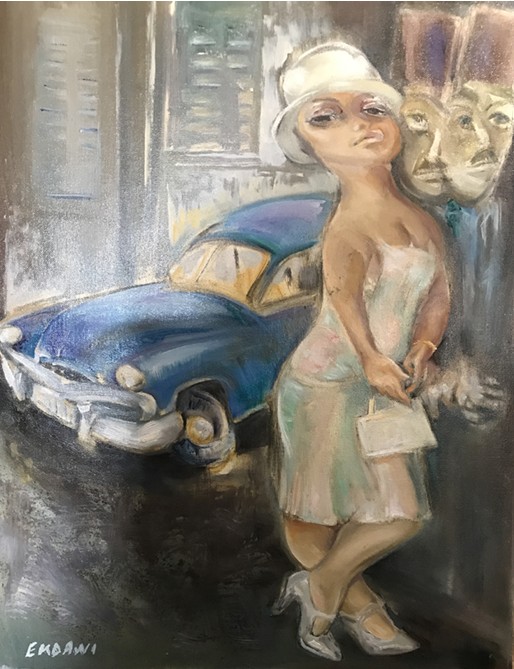
The paintings in this exhibition are ‘mindscapes’ in the sense that they represent memories, dreams and imaginings. Almost all Ekdawi’s paintings are portraits, but prior to his retirement from psychiatry in 1993, he painted from life. His first exhibition (at the Atelier des Beaux Arts in Alexandria in 1953) included portraits of family members and fellow-artists; his later paintings were mostly of family and friends. His daughters remember being very fidgety, reluctant sitters as children!
Ekdawi’s late paintings, completed after taking early retirement to focus on his art, are sometimes based on old family photographs but more often on memories and his imagination. Some of the imagined scenarios are strange, some are playful, and some appear to make satirical allusions to the mind and psychiatry (e.g. ‘In Two Minds’ and ‘Third Party’). Lifelong sources of inspiration for Mounir’s art were Coptic icons and the Fayoum portraits. His chief modern influences were Picasso and Francis Bacon.
Mounir Ekdawi was a renowned psychiatrist, and Fellow of the Royal College of Psychiatrists. He was a pioneer of psychiatric rehabilitation, co-author with Alison Conning of ‘Psychiatric Rehabilitation’, and an advocate of art therapy (he worked with Edward Adamson at Netherne Hospital). His BMJ obituary (by Panos Vostanakis) describes him as an 'acclaimed artist' (BMJ, 2023), and his reputation is growing. Some of his paintings are currently being transferred to European museums of psychiatry.
Artist's biography: Dr Mounir Ekdawi, FRCPsych (1930–2023)
The Egyptian artist and psychiatrist, Mounir Youssef Ekdawi, was born in Mansoura in 1930, the son of Dr George and Mme Marie Ekdawi. He had two elder sisters and a younger brother.
Educated in French, Arabic and English, Mounir had passed all his school exams by the time he was fifteen. A few months before his sixteenth birthday, he was admitted to the Medical Faculty at Alexandria University. He spent his student years at a family-run Italian pensione, where he learnt to speak Italian and cook Italian food. During his medical studies, he continued to paint, and took art lessons at the famous Atelier des Beaux Arts, Alexandria. Mounir’s first solo exhibition was held at the Atelier shortly after his graduation, in 1953. Photos, invitations and a review have been preserved.
In the spring or early summer of 1953, Mounir left Egypt, initially for further medical training. He reregistered his medical qualifications at Edinburgh University and then worked at the Rotunda Hospital in Dublin, obtaining qualifications in gynaecology and pharmacology. He later returned to Edinburgh, where he specialised in psychiatry at the Royal Infirmary. From Scotland he went on to a position in Harpenden, which included training in neurosurgery, and worked in Hove before joining Netherne Hospital in Surrey, where he later became the senior consultant, a strong proponent of art therapy and a leading expert in psychiatric rehabilitation.
In 1957, in Hove, Mounir met his future wife, Pamela Toop, an occupational therapist (and exceptionally skilled craftswoman), who later taught him sculpture techniques. They married and had three daughters. In January 1978, almost twenty years after their wedding, Pam died, aged only 44, from cancer.
Mounir never stopped painting. He would get up at 5am every morning and paint before work. With Pam’s encouragement, he also experimented in a range of other media, including wood and copper. They worked together on creating wooden dolls in historical and contemporary dress. After practising medicine for over 30 years, Mounir took early retirement to paint full time.
In 2023, 45 years and a day after Pam’s death, Mounir died of COVID-19. He is survived by his second wife, Susan.