
Resources and guides
The resources and guides on this page should help you get started in your journey to observe, appreciate and identify bees in the UK.
A guide to spotting bees
- Bees need food – they drink nectar from flowers to help fuel themselves and collect pollen for their young. Where there are flowers, there are bees!
- In general, bees do not like standard bedding plants, like roses, dahlias, and pansies, because these have been selectively bred for complex petal patterns or scent/colour and do not have a good supply of nectar or pollen.
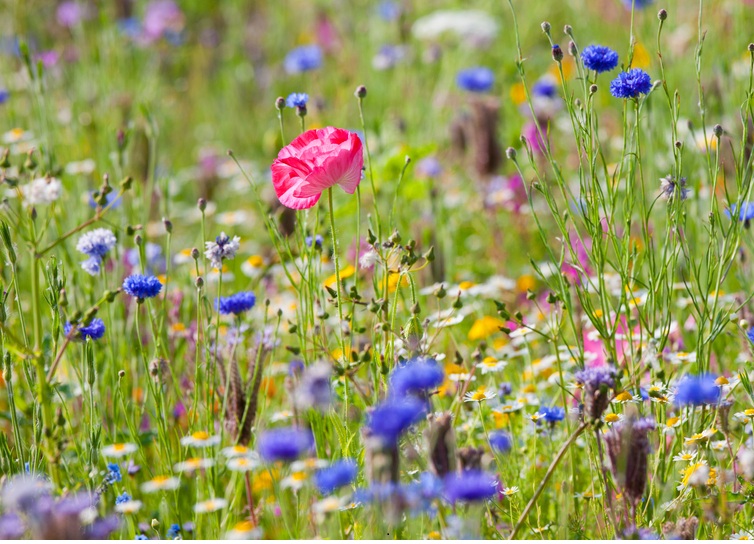
- Bees like wildflowers like daisies, foxgloves (loved by the longer-tongued common carder and garden bumblebees), dandelions, bramble, green alkanet, and lots more. Urban and suburban gardens are a great habitat. Bees especially love herbs such as rosemary, thyme, lavender, catmint and marjoram. In the early autumn, check ivy flowers for the presence of the charismatic ivy bee (see image below).
- Explore suburban streets, gardens, parks, and local nature reserves. Natural wildflower meadows are fantastic for bees, but not many of us are lucky enough to live near one of these. Seaside and estuarine areas are brilliant for insects. Woodland areas are generally not that good unless they have plenty of sunny glades and wide woodland rides.
Look out for the ivy bee around Ivy flowers in the early autumn:
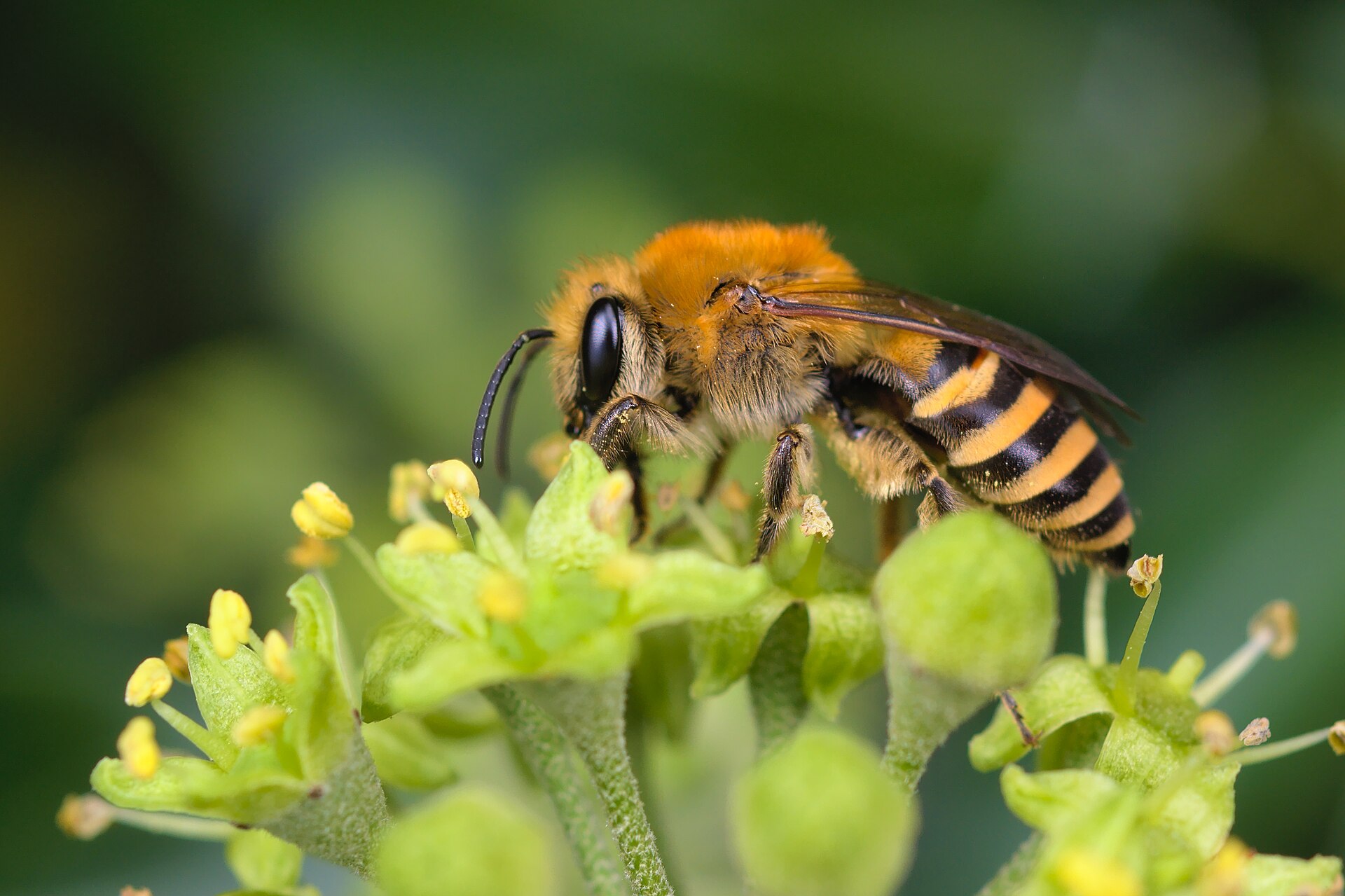
Image Credit: Gilles San Martin licensed under a CC BY-SA 2.0 license.
Bees belong to the taxonomic order Hymenoptera which includes bees, wasps and ants. They evolved originally from a wasp, hence they have a narrow waist similar to, but quite as thin as, the wasps. Unlike wasps, bees are vegetarian. feeding on pollen and nectar from flowering plants
Bees are generally hairy, with longer antennae than flies, and much smaller eyes than flies.
The Bumblebee Conservation Trust website has a lot of information, and has a link to download the PDF, which tells you in simple terms how to differentiate honeybees, solitary bees, and bumblebees.
There are roughly 280 species of bees in the UK. It is a myth that they are only found in remote wild places or nature reserves. In fact, the former industrial sites around the Thames Gateway and South Wales are some of the richest sites for invertebrates – including bees – in Europe. But don’t worry if you live in Fife, County Armagh, Pembrokeshire or Cornwall – because wherever you are in the UK, there are bees.
Contrary to popular belief, the honeybee (Apis mellifera) is not a wild animal. It is a domesticated insect introduced from Asia to produce honey. It lives for the most part in man-made hives. It is not endangered. In fact, too many beehives containing honeybees can put other bees at risk as they compete for scarce food resources. Responsible beekeepers are now advocating for a restriction on beehives in the UK, particularly in urban areas where people are taking up beekeeping in the (false) belief that it is good for the environment.
Here’s a picture of a honeybee. They are variable, and it is sometimes difficult to differentiate them from other bees.
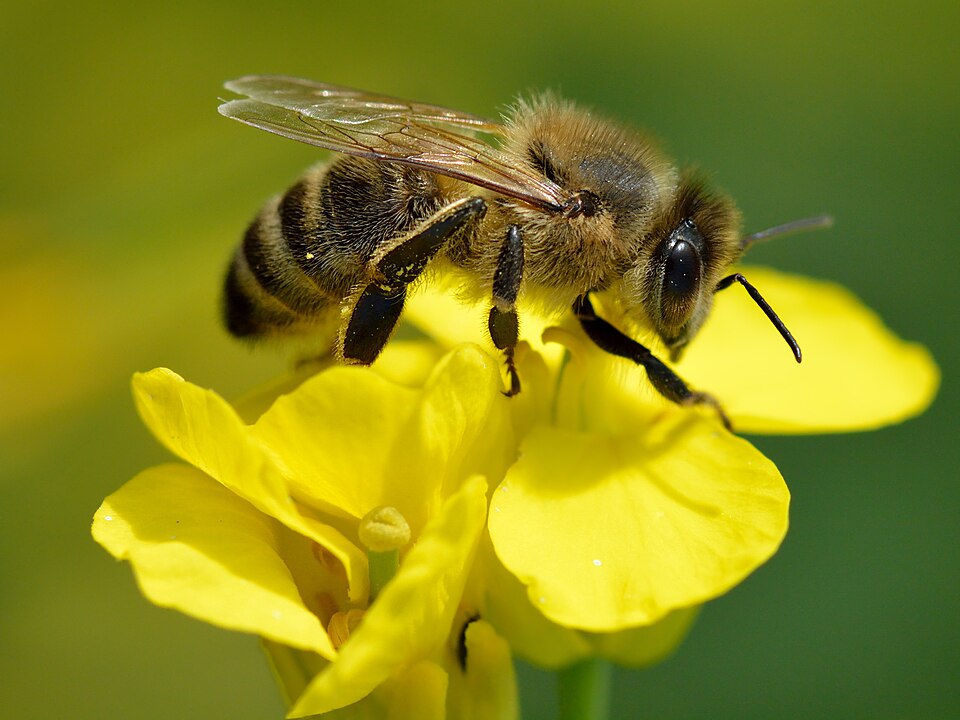
Image credit: Ivar Leidus licensed under a CC BY-SA 4.0 license.
There are 250 or so species of solitary bees in the UK. Most people are not aware of these wonderful animals. Solitary bees are so- called because they don’t nest in hives or communal nests. They lay their eggs in little tunnels in lawns and grassland, in the mud of the woodland floor, in sandy banks and in the crumbling mortar of buildings and old walls. They often look like darker versions of honeybees, but some of them are very dramatic. If you see a lot of bees flying around over a lawn, they are often solitary bees looking for a suitable nest site. Keep your eyes open, once you spot one, you will see them everywhere.
Here is a photo of a Tawny Mining Bee.
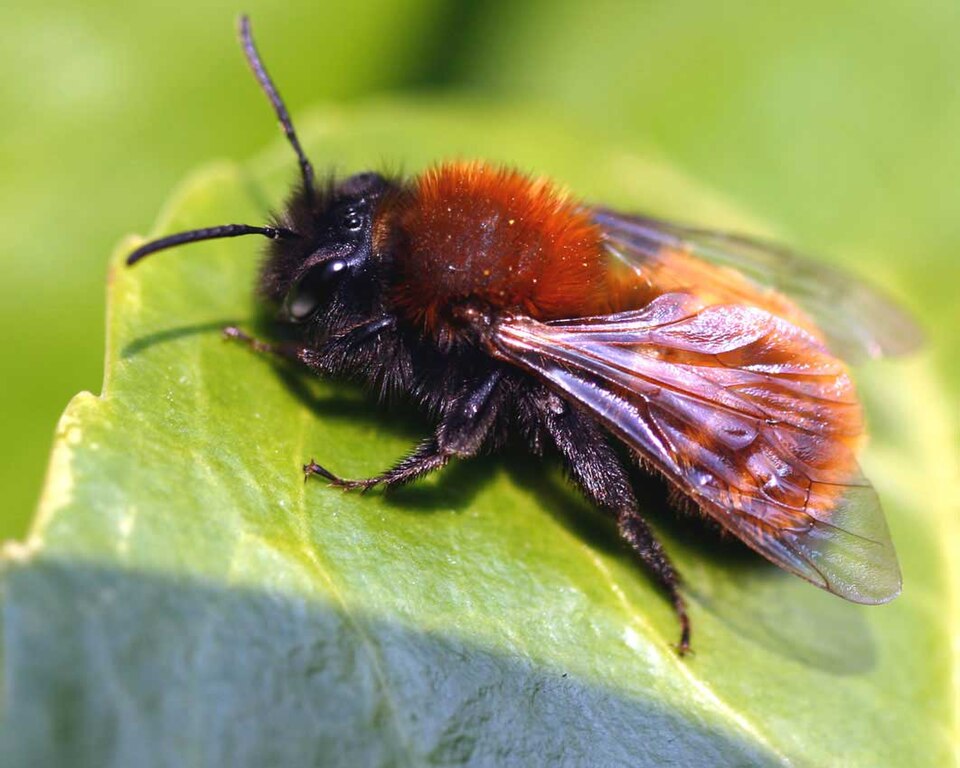
Image Credit: entomart
If you live in the Midlands and the south of England, there is one very common, but rather special and characterful solitary bee that you should know about. This is the Hairy-Footed Flower Bee (Anthophora plumipes) who is one of the first bees to emerge in early spring. They are very furry and look like bumblebees and have a characteristic hovering darting flight. The male is a smart ginger and the female immaculate in black, contrasting with her yellow pollen baskets on her hind legs which she uses to collect pollen to feed her young.
Here is a photo of the male Hairy-Footed Flower Bee.
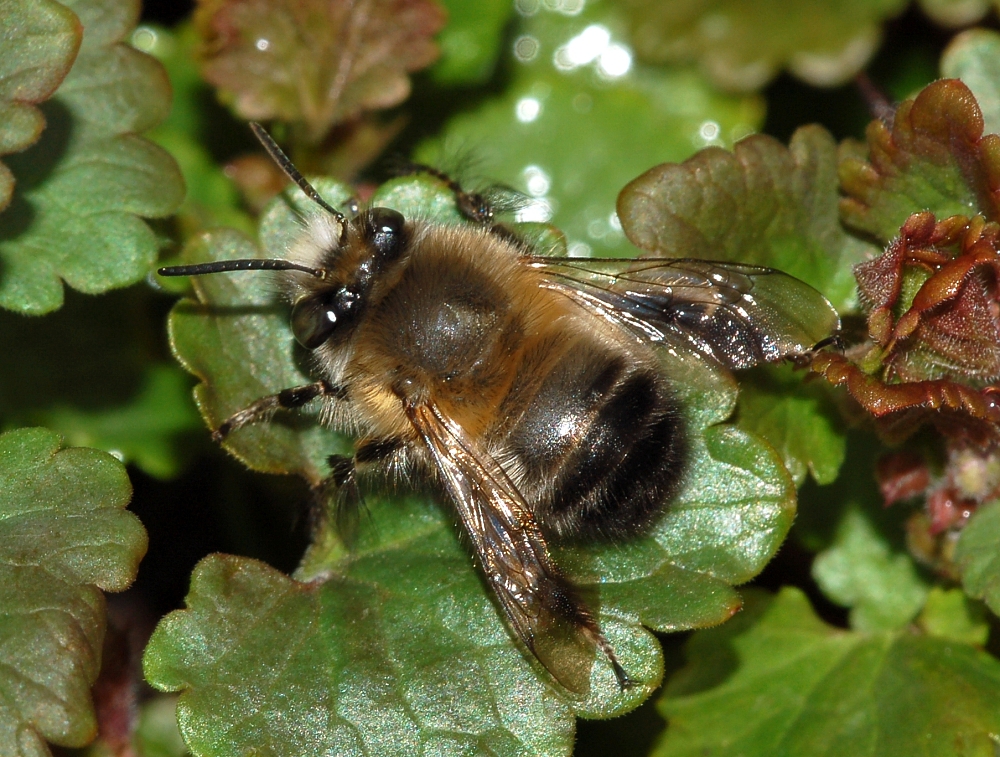
Image credit: Fritz Geller-Grimm licensed under a CC BY-SA 2.5 license.
Here is a photo of the female Hairy-Footed Flower Bee.
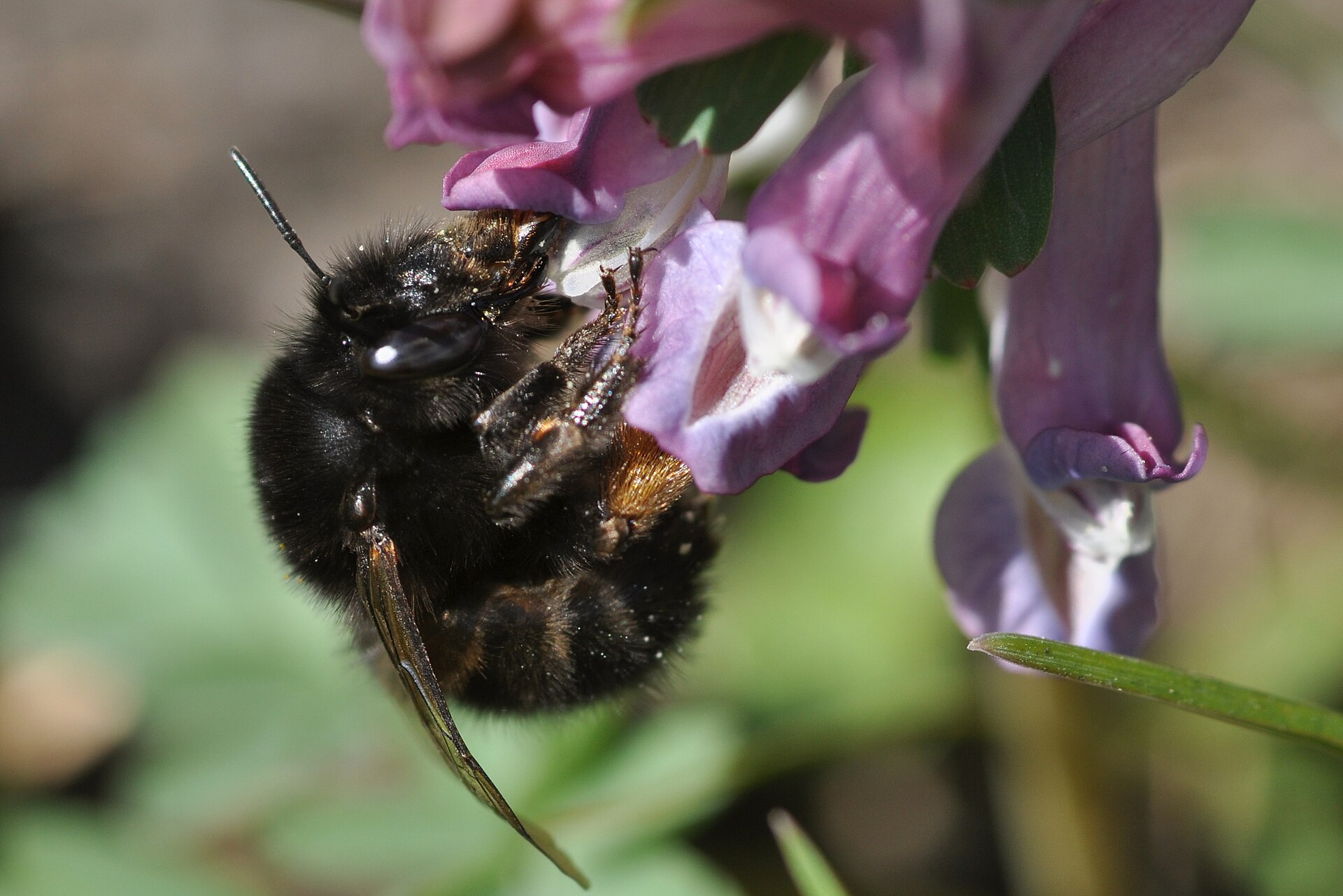
Image credit: Aiwok licensed under a CC BY-SA 4.0 license.
We all know bumblebees - the big round, furry ones with a deep buzz. But what people often don’t know is that there are 24 different species.
Many of these are incredibly rare, but there are seven or eight species that are pretty common and widespread throughout the UK. Although recent evidence suggests that many of our more common bees are declining, especially in intensively farmed land with few wildflowers.
Use this guide to help you identify some of the more common bumblebees in the UK.
Where can I find out more about bees?
The best place to start for bumblebees is on the Bumblebee Conservation Trust website. Try these pages first:
And for solitary bees:
The Bumblebee Conservation Trust site has helpful identification tips, lively videos, information about wildlife gardening and an online shop where you can get bumblebee badges and brilliant little fold-out guides you can carry with you wherever you go.
Their bumblebee poster would be a lovely addition to the wall of any ward, clinic or CMHT base.
This BBC4 programme is available on iPlayer and is a good starting point for any budding bee enthusiasts: My Garden of a Thousand Bees - BBC iPlayer (access might be restricted to UK residents).
Here Dan talk about his volunteering with the Bee Walk project at the Horniman Museum and Gardens.
The Bumblebee Conservation Trust sell a little book called Bumblebees: an introduction written by Dr Nikki Gammans which has clear photos of all the bumblebees and a lot more information about their habits life cycle and conservation.
Other books, guides, ID packs and posters can be purchased from.
For those of you who are very keen the most detailed field guide is The Bees of Great Britain and Ireland by Stephen Falk.
Steven also has an incredibly comprehensive gallery of bee photographs on flickr.
Last but not least, the Field Studies Council have a great selection of laminated fold out guides to common insects and other wildlife, which are great for taking into the field. The bee one though, is not their best.
The iNaturalist App can be used to help you identify bees (and indeed any animal or plant) in your photo, and can usually tell you if your insect is a bee or a hoverfly (sometimes it's not that easy). We don’t recommend it for complete beginners though, as it needs a little knowledge to get the most out of it.
The app is available on App stores: A Community for Naturalists · iNaturalist United Kingdom
The Bumblebee Conservation Trust also as an identification app: Get our free bumblebee ID app - Bumblebee Conservation Trust
You can look on your phone's app store for more apps – there are lots!
We have nature-related CPD eLearning podcasts available on the following:
If you want to listen to these podcasts on the go, the audio files can be freely accessed on SoundCloud, Spotify and Apple Podcasts.
You can earn CPD points after listening to these podcasts by taking the short podcast tests via CPD eLearning. To complete eLearning based on these podcasts – and access other eLearning content – simply login or subscribe.
Bee code of conduct
- For this project, please don’t try to catch or trap bees! This can be distressing and harmful to bees unless done skilfully. Please be patient, let your bee settle and try to take a photograph.
- Please avoid trampling through woodland or wildflower meadow in order to get a good picture. In urban areas particularly, nature reserves are becoming severely damaged by high footfall. Keep to the footpaths.