
Mass observation - from ‘Worktown’ to your working life in 2026
27 February, 2026

By Dr Graham Ash, Chair of the History of Psychiatry Special Interest Group at the RCPsych.
As part of the RCPsych’s celebration of the centenary of its Royal Charter, it is aiming to record a snapshot of what psychiatry is like in 2026. RCPsych members, staff, and patient and carer representatives are being invited to capture their day on the week of the celebrations. The entries will become an invaluable resource for future researchers. To give the exercise a little context, this blog will discuss the history of mass observation exercises, such as the one we are embarking on.
Our event is inspired by the Mass Observation studies which began in the mid-1930s. Despite social change following the First World War, British society remained sharply divided along class and regional lines. The abdication of King Edward VIII in 1936, divided opinion and exposed gaps in the understanding of politicians of the majority, the working people of Britain. In a strident letter to the New Statesman the journalist, Charles Madge, one of the founders of Mass Observation, drew attention to the need to understand the opinions of the working ‘masses’.
He was soon joined by the social anthropologist, Tom Harrisson and artist and documentary photographer, Humphrey Jennings. Together, in early 1937, they issued a manifesto-like statement proposing the development of an ‘anthropology of our own people’, and their imminent intention to recruit thousands of observers across the country to do so!
‘Mass Observation develops out of anthropology, psychology, and the sciences which study man—but it plans to work with a mass of observers. Already we have fifty observers at work on two sample problems. We are further working out a complete plan of campaign, which will be possible when we have not fifty but 5,000 observers.’ (Harrisson et al, New Statesman, 1937).
Within weeks, Harrisson and Jennings were in Bolton which, as a typical northern working town, they adopted as ‘Worktown’ and where they established their first observation outpost. An eclectic group of ‘observers’ soon joined them and immersed themselves in local working life. Attempting to go unnoticed to covertly observe ordinary peoples’ everyday lives, they frequented pubs and dance halls, places of worship and funerals, markets, cinemas and sporting events and even worked in local mills and industries. However, the efforts of the observers were not always appreciated by others, as photographer Humphrey Spender found when discovered hiding a camera beneath his coat in a public bar!
Methodology
In its early days, the Worktown study was more than somewhat haphazard in its methods, which were lacking in scientific rigour, although often expressing the group’s interest in surrealism! Harrisson would set a task for the day and his observers then left their base to carry this out. A similar task would be set once a week for the network of observers who had been recruited nationally.
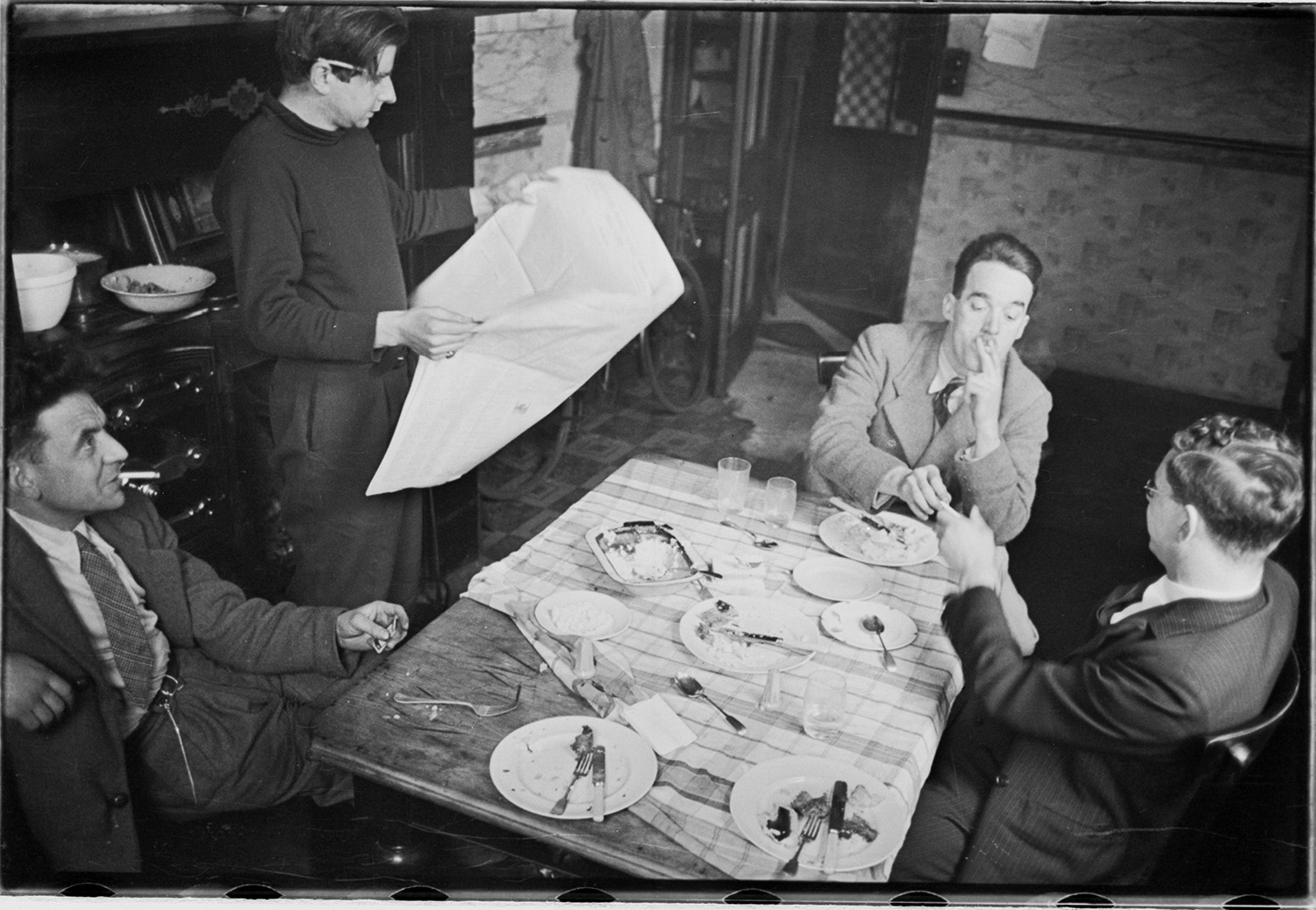
Planning observations at 85 Davenport Street. Humphrey Spender. April 1938 Image ref. 1993.83.19.09 © Bolton Council. From the collections of Bolton Library and Museum Services.
Observation and report writing
Where possible observations were made covertly - this would be highly problematic today! - and were written down as soon as possible afterwards. Observers attempted to make verbatim records of conversations they had overheard in the street, marketplace, pubs and dance halls … and other public places. A team of observers recorded ‘A Day in the Life of a Street’ in great detail, and one observer was even assigned to record the selling of potatoes at a stall in the local market for days on end!
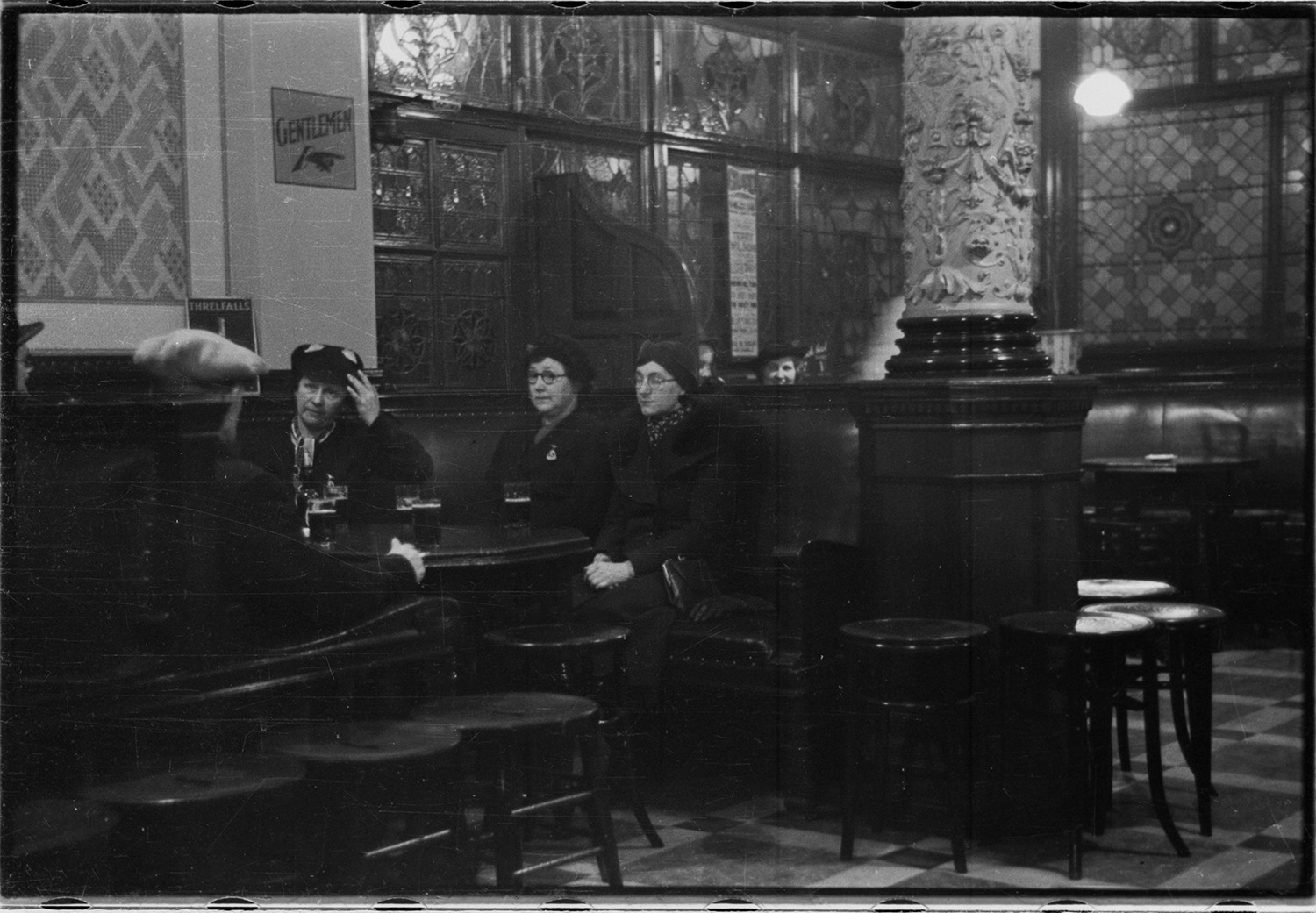
Pub Interior. Humphrey Spender. Image ref. 1993.83.28.03 © Bolton Council. From the collections of Bolton Library and Museum Services.
The observers became adept at recording conversations word for word and sometimes reported colourful accounts of events. Objectivity was an important principle without any attempt to support or refute underlying theory or to systematically collect ‘data’. No attempt was made to analyse the ‘data’ during observations, nor to collect data to support an underlying theory, on the basis that this could not be presumed or deduced until data collection was complete and the complete data set had been analysed.
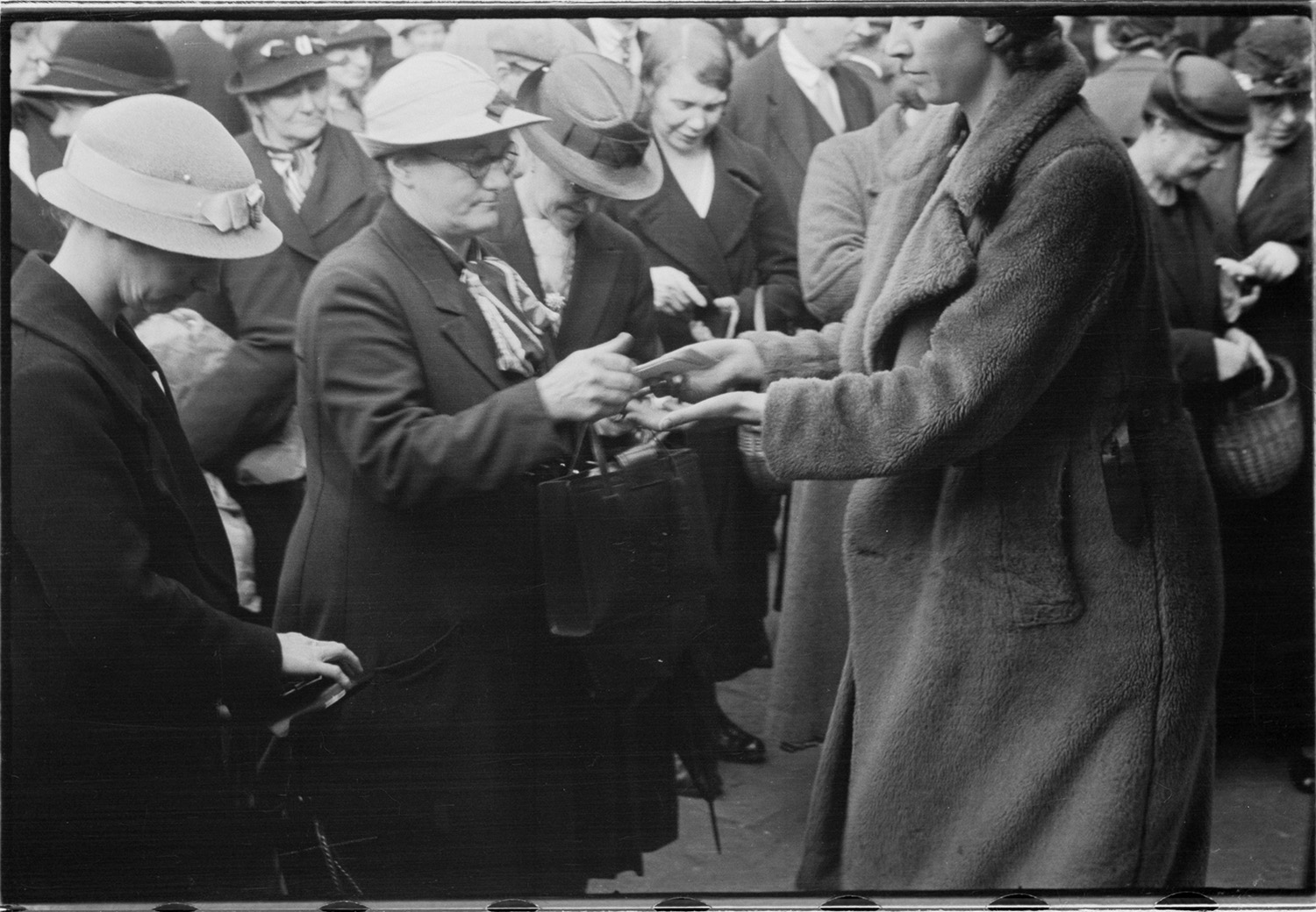
Quack Medicine Stall. Humphrey Spender. Thursday 23 September 1937. Image ref. 1993.83.01.37. © Bolton Council. From the collections of Bolton Library and Museum Services.
Diary keeping
Detailed journaling became an important method for observers and was utilized to great effect to record public reactions on the day of the Coronation of King George VI in May 1937. This methodology provided the basis for the group’s first publication, May 12 1937: Mass Observation Day Survey .
Visual arts
The artistic outputs of Mass Observation have become one of the most enduring and accessible legacies of its studies of everyday life. A body of important visual art and documentary photography developed from Harrisson’s approach to art.
‘It is because we distrust the value of mere words that we are keen to employ artists and photographers.’
Members of the Euston Road group of modernist artists, Graham Bell, William Coldstream, Humphrey Jennings and Humphrey Spender, interpreted the industrial townscape of Worktown in sketches, paintings and collage, which Spender extended to record people and action through photographic imagery, which he sometimes staged and sometimes even obtained covertly.
The formulation of social theory was expected to follow from data collection but most of the reports made by the observers were simply filed away and went unanalysed! It was largely due to interventions made by Gertrude Wagner, a social psychologist and refugee from National Socialism in Austria who joined the study in 1938 and introduced scientific rigour and organisation, that the project moved forward to become one of the foundations of modern social psychology and market research.
Above all, the Mass Observation studies remind us that as psychiatrists, without first listening, we should not presume to understand the lived experiences of others, their attitudes, values and aspirations.
Become an observer for a day!
The original Mass Observation projects have left a legacy of immense importance to our understanding of the social history and everyday life and attitudes in the 1930s and 1940s. These kind of everyday experiences, feelings and attitudes are what we would like to capture from our members in 2026. Our working lives today are certainly different to those of our forebears in 1926 and will likely be very different to those of people working in mental health in ten, twenty or three hundred years’ time. I hope that these reflections on the historical origins of Mass Observation will encourage you to participate in our project and make sure we don’t lose your experience to history.
Help us create a picture of psychiatry in 2026!
Further reading
- Graham M. Davies and Alan Costall. ‘Mass observation – ‘the science of ourselves’. The Psychologist. 4 Feb 2019. Accessed: 8/01/2026
- Harrisson, T, Jennings, H and Madge, C. ‘Anthropology at Home’, letter to the New Statesman, 30 January 1937.
- Humphrey Jennings and Charles Madge (eds), May 12 1937: Mass-Observation Day-Survey. Faber & Faber,1937.
- Humphrey Spender’s account of his confrontation with the landlord of the Saddle Hotel on 22 January 1938 Saddle Hotel | Bolton Worktown Accessed: 30 January 2026
- David Hall. Worktown: The Astonishing Story of the Project that launched Mass Observation. 2015. Weidenfeld & Nicolson. Kindle Edition.
- Bolton Worktown - Photography and Archives from the Mass Observation project. Accessed: 8/01/2026.